12. Economy
All nations share one production model: land + labor + tools → goods. What differs is the allocation layer: who owns, who decides, and how goods reach citizens.
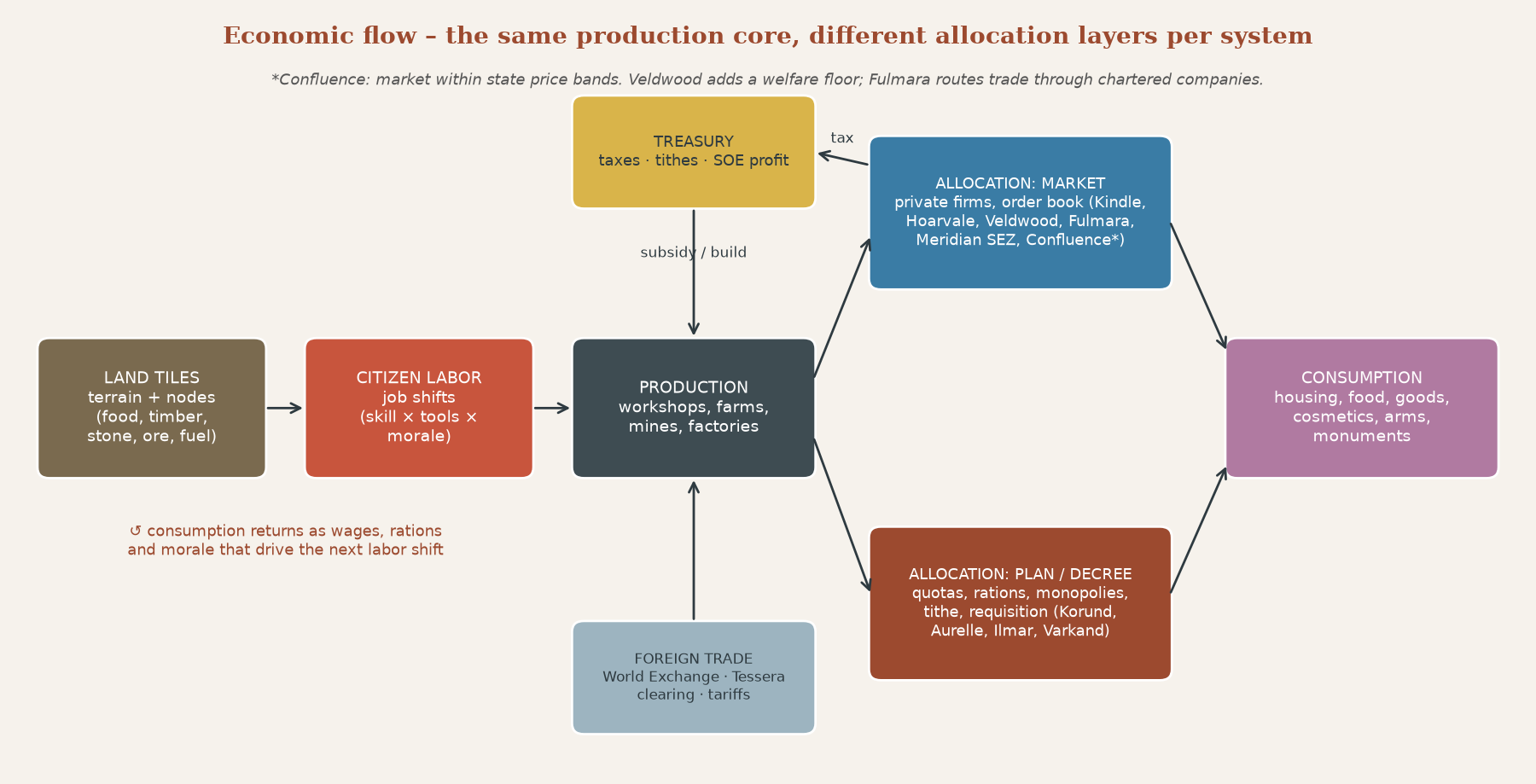
12.1 Resources
| Tier | Resources | Uses |
|---|---|---|
| Basic | Food, timber, stone, ore, fuel, fiber | Consumption, construction, tools, cloth. |
| Processed | Tools, cloth, bricks, steel, goods, arms, medicine | Productivity, cosmetics, military, wellbeing. |
| Signature (one per nation) | Emberstone (Kindle), Riverpearl (Confluence), Geotherm core (Meridian), Ironroot (Korund), Skysilk (Aurelle), Sunglass (Ilmar), Frostcore (Hoarvale), Hazequartz (Varkand), Heartwood (Veldwood), Stormcells (Fulmara) | National bonuses and high-value exports; each nation’s best industry depends on at least two other nations’ signature goods to encourage trade. |
| Commons rares | Three unique node types in the Commons (names TBD); at ten nations, a second ring of nodes (Section 6.3) | Wonders and late-game technologies; main driver of world conflict. |
12.2 Allocation by system
| Nation | Ownership | Price formation | Who decides output | Tax / revenue |
|---|---|---|---|---|
| Kindle | Private (citizens, companies, shares) | Free market order book | Firms and consumers | Income, sales, land taxes set by Assembly |
| Confluence | Cooperatives + SOEs + household business | Market within state price bands for staples | Guidance Plan targets + cooperative votes | Cooperative levy + SOE profits + modest income tax |
| Meridian | SOEs + licensed private + SEZ firms | Market; capital controls; SEZ free trade | Party direction via SOE executives; SEZ market | SOE profits, enterprise tax, SEZ fees |
| Korund | State (all productive assets); personal items only | Fixed prices; rations; illegal gray market | Five-Year Plan quotas set by Plan Commission | Direct state ownership of output |
| Aurelle | Crown, nobles (fiefs), guilds, commoners | Chartered markets; royal monopolies fix prices on monopoly goods | Monarch, lords, guild masters | Royal taxes, fief tribute, monopoly rents |
| Ilmar | Endowments + private | Market with ‘fair-light’ caps on staples | Endowment stewards + market | Tithe (flat share of income), endowment returns |
| Hoarvale | Private; Trading Houses with cross-holdings | Free market; indicative guidance | Trading House boards + market | Income, corporate and land taxes set by the Moot |
| Varkand | Arsenal Combines + licensed private | Market at Green; price controls and requisition at Red | Directorate via Arsenal; civilian market | Combine output, security levy, requisition |
| Veldwood | Private + Common Fund holdings | Free market; sector wage floors | Firms, consumers, social partners | High progressive income tax, Grove taxes, Common Fund returns |
| Fulmara | Private chartered companies | Free market; route monopolies | Charter-holding companies | Charter auctions, port tolls, excise (low) |
12.3 National currencies (v0.3 – replaces the element attribute)
Every nation issues its own currency, and the currency behaves like the nation’s economic system: a capitalist float that can crash, a socialist band, a pegged and controlled party-state currency, a non-convertible ration economy, a gold coin a king can debase, money under faith rules, a dividend currency, and shareholder bank money. Citizens feel the system every time they are paid, shop or travel. All names are original working names pending the trademark search (Section 1.4).
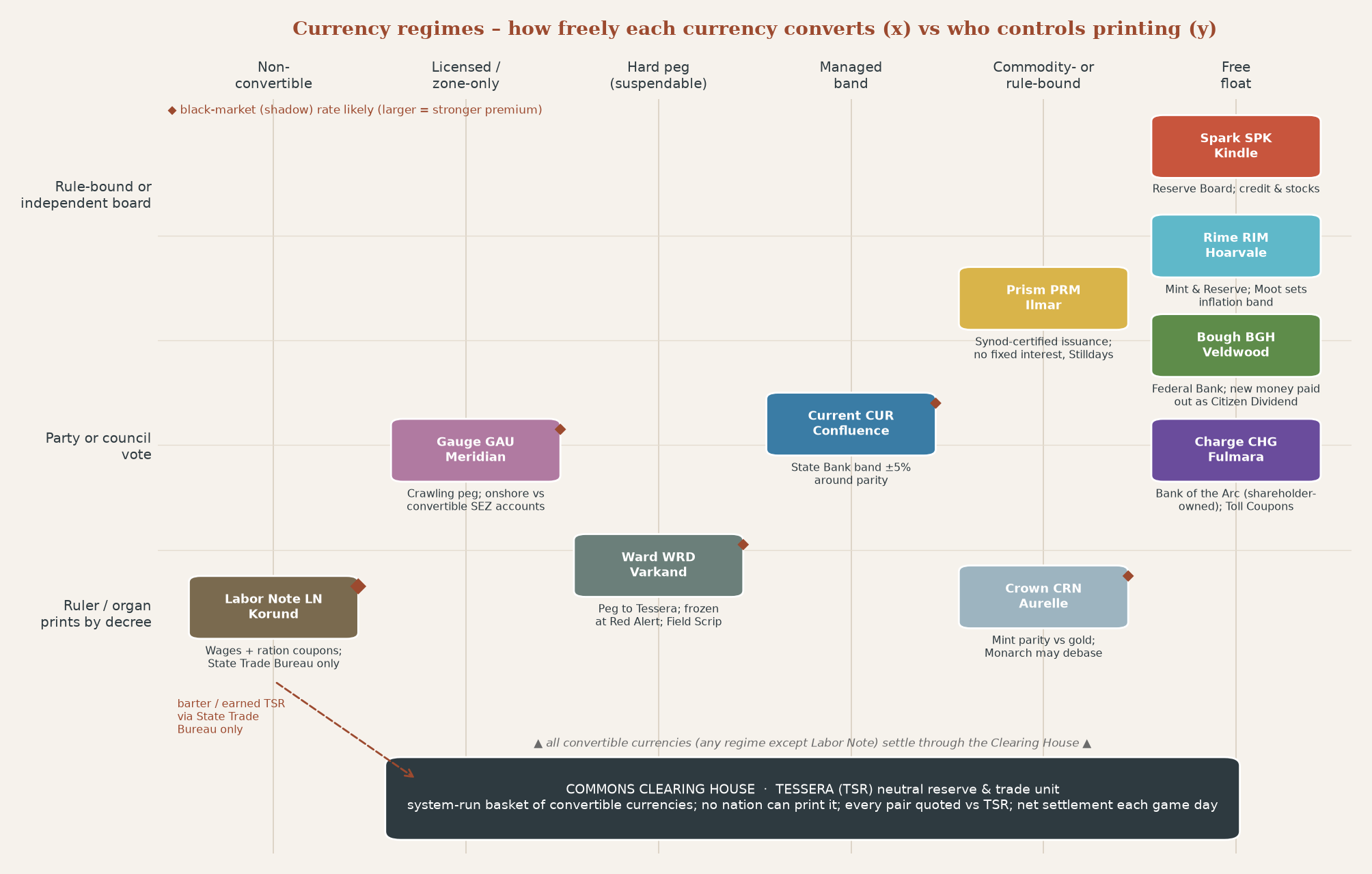
| Nation | Currency (code) | Regime | Who prints / sets the rate | Distinctive behavior | Black-market pressure |
|---|---|---|---|---|---|
| Kindle | Spark (SPK) | Free float | Independent AI Reserve Board (5 AI governors; nominated by the AI President, confirmed by the AI Assembly; staggered terms) | Private banks, interest-bearing loans, deposits, stock market; booms, busts and bank runs are possible; deposit insurance only if legislated | Very low |
| Confluence | Current (CUR) | Managed band ±5% around a central parity [ASSUMPTION] | State Bank under the Premier; parity reviewed each game quarter by the Politburo | Cooperative credit unions; staples priced in bands; per-citizen limit on converting Currents abroad each game month | Low (a ‘kerb rate’ appears when the band is far from the market) |
| Meridian | Gauge (GAU) | Crawling peg to the Tessera; capital controls | Standing Committee (peg moves ≤ ±2% per game month [ASSUMPTION]); People’s Bank runs reserves | Two tracks: onshore Gauges are convertible only with a licensed quota; SEZ accounts convert freely. Big reserves let Meridian keep the Gauge cheap to boost exports | Medium (quota arbitrage between SEZ and onshore) |
| Korund | Labor Note (LN) + ration coupons | Non-convertible | Plan Commission under the Chairman | Wages in Labor Notes at fixed prices; weekly coupons for food, clothing and goods that expire and are non-transferable; foreign trade only through the State Trade Bureau (barter or earned Tessera). Extra printing shows up as shortages and queues, not price rises (repressed inflation) | High – foreign cash is illegal, so a street rate thrives |
| Aurelle | Crown (CRN) | Gold-backed coin | Monarch by decree; Royal Mint and Royal Treasurer | Convertible to bullion at a declared mint parity. Debasement (more Crowns per bar) gives the crown an instant windfall but drops Currency Confidence; full-weight old coins are then hoarded and trade at a premium | Low–medium (spikes after debasement) |
| Ilmar | Prism (PRM) | Float under faith rules | Treasury of Endowments; issuance certified by the Guardian Synod | Fictional Clear Measure rules: no fixed-interest loans – credit via profit-sharing Lightshare partnerships and asset-backed leases; no short selling or leverage; trading pauses on Stilldays; tithe collected in Prisms | Low (‘shadow lending’ at interest is a canon offense) |
| Hoarvale | Rime (RIM) | Free float with an inflation band | Independent Mint & Reserve; the Moot sets the target band each term | Conservative ‘safe’ currency; Trading House bonds; coins restruck with each new Sovereign’s portrait (cosmetic) | Very low |
| Varkand | Ward (WRD) | Hard peg to the Tessera; suspendable | Arsenal Marshal with Directorate approval | Convertible at the peg at Green; quotas at Amber; convertibility suspended and foreign balances frozen at Red Alert; troops and requisitioned firms paid in Field Scrip, redeemable for Wards after the alert | Medium (a ‘fog rate’ when the peg is set too high) |
| Veldwood | Bough (BGH) | Free float, dividend currency | Federal Bank (board elected by the Federal Assembly); issuance rule changeable only by referendum | People’s issuance: new Boughs created for growth are paid out equally in the yearly Citizen Dividend, alongside Common Fund resource rents – no money enters through banks first | Very low |
| Fulmara | Charge (CHG) | Free float, bank money | Bank of the Arc – a chartered bank owned by Charter Shareholders; Council of Ten can impose reserve rules | Most Charge is bank deposits; dividends paid in Charge and in Toll Coupons (tradeable tokens redeemable against future port tolls); a bank run on the Arc is a real crisis that the Council must resolve | Low (but a money-laundering magnet – Section 12.10) |
Design note. These regimes are stylized analogues of broad real-world monetary arrangements (floating, banded, pegged, commodity-backed, non-convertible), simplified for play. The faith-finance rules of the Prism are invented for the Lumen Canon and are not modeled on any real religion’s law.
12.4 Money supply, printing powers and inflation
Each nation has one money-supply lever. Who holds it, and how far they can pull it, is part of the immutable system; since v0.7 every printing authority below is an AI body, and the caps are hard limits in its legal action set (Section 8.18). Inflation follows a deliberately simple, visible rule: the national Price Index drifts toward money supply ÷ real output with a lag of a few game weeks [ASSUMPTION – tune in bot simulations]. Fixed-price systems (Korund always; Confluence staples; Varkand at Red Alert) show the same pressure as shortages, queue times and a widening black-market premium instead of price rises.
| Nation | Printing authority | Normal cap per game month | Emergency route | Typical temptation and consequence |
|---|---|---|---|---|
| Kindle | Reserve Board | Up to 3% of money supply [ASSUMPTION] | Assembly 2/3 can order a one-off stimulus up to 10% | Cheap money before elections → inflation and a falling Spark after them |
| Confluence | State Bank (Premier) | 3% | Politburo + 3 of 4 Pillars, up to 10% | Defending the band drains reserves; re-centering the parity is a Congress-level fight |
| Meridian | Standing Committee | 4% | Standing Committee 5/7, up to 12% | Undervaluation boosts exports and reserves but invites tariffs and sanctions |
| Korund | Plan Commission (Chairman) | 5% of Labor Notes | Chairman alone, up to 15% | Paying bonuses in unbacked notes → empty shelves, rising street rate, Unrest |
| Aurelle | Monarch | Re-coinage within 5% | Debasement by decree, up to 15% per game year | Windfall for wars and festivals → lost Currency Confidence, hoarding, angry nobles |
| Ilmar | Treasury of Endowments + Synod certification | 3% | Oracle’s Edict, up to 8% | Low inflation, slow credit; interest-free rules limit leverage booms and busts alike |
| Hoarvale | Mint & Reserve (independent) | Whatever keeps inflation inside the Moot’s band | Moot majority can widen the band once per term | Stable, trusted; governments complain the Reserve is too tight |
| Varkand | Arsenal Marshal (Directorate) | 4% | Directorate majority at Red Alert, up to 15% in Field Scrip | War financing through scrip → post-alert redemption crunch |
| Veldwood | Federal Bank | Rule-based issuance paid as dividend | Referendum only | Voters may vote themselves a bigger dividend → inflation they then feel |
| Fulmara | Bank of the Arc (shareholders) | Reserve ratio set by the Council of Ten | Ten majority | Credit booms that enrich holders; bank runs hit small depositors first |
- Hard ceilings (Charter Limit, confirmed v0.4): no nation can create more than 15% of its money supply in one game month by any route, and no more than 30% in a game year [ASSUMPTION]. A full hyperinflationary collapse therefore cannot happen: no currency becomes worthless, is abolished or has to be replaced, and there is no ‘currency collapse’ event.
- Reckless printing still hurts (v0.4): printing at the ceiling year after year compounds – 30% a game year is roughly 2.2× in three game years (about three real months) – and brings painful, visible inflation: wages, rations-in-cash and dividends lag prices, savings erode, the exchange rate and Currency Confidence fall, import prices and the black-market premium rise, Unrest grows and World Reputation drops. It is a political disaster for the rulers who chose it, not a broken server.
- Currency reform: if the Price Index rises above 3× its Age starting level, the authority may hold a redenomination (drop zeros; new notes art) – a purely cosmetic reform that restores a little Currency Confidence; balances are converted exactly and nothing is wiped [ASSUMPTION].
- Currency Confidence (0–100) falls with inflation, reserve losses, debasement, devaluation, sanctions and lost wars; it raises or lowers the exchange rate’s ‘fundamental drift’ (Section 12.6), the black-market premium (Section 12.9) and feeds Stability.
- Money sinks (critical for a persistent economy): taxes, upkeep, construction, decay of tools and clothes, war losses, market and exchange fees, temple building and charity. Every source of money must be matched by sinks in balancing reviews.
12.5 The Tessera and the Commons Clearing House (neutral reserve and trade unit)
A world of ten currencies needs a neutral yardstick that no player government controls. The Commons Clearing House is a system-run, neutral institution (like the World Registry that sells Wildlands) seated in the Commons. It issues the Tessera (TSR) – named for the small square tiles of a mosaic, echoing the map’s squares.
- What it is: a unit of account and reserve asset defined as a basket of the convertible currencies, weighted by each nation’s share of settled world trade over the previous Age, re-weighted at each Age boundary [ASSUMPTION]. Korund’s Labor Note is never in the basket.
- How it is created: only when a treasury, licensed bank or chartered company deposits basket currencies with the Clearing House (and destroyed when they are withdrawn), plus a small issue backed by royalties from jointly developed Commons rare nodes. No nation can print Tessera.
- Who holds it (decided v0.4): treasuries, central banks, licensed exchange dealers, chartered companies – and ordinary citizens. Any citizen may hold Tessera and trade currencies through licensed exchanges (licensed dealer desks, bank counters and Clearing House kiosks), within their home system’s limits: only the verification-tier limits in the free-floating nations, quotas and caps in the controlled economies, and none in Korund, whose non-convertible system is fixed (Section 12.8).
- What it is used for: quoting every currency (one order book per currency against TSR), settling cross-border trade, pricing treaties, land sales, reparations and aid, and holding national reserves that a single rival cannot freeze.
- Neutrality: the Clearing House has no officials at all – human or AI – and runs on system rules only; it cannot be captured in war; Commons conquest does not give control of it. It can only be restricted by the multilateral rule in Section 13.3.
12.6 Exchange rates and the World Exchange
| Aspect | Design |
|---|---|
| Order books | One order book per currency against the Tessera; cross rates are always derived through TSR, so triangular arbitrage loops cannot exist by construction. |
| Participants | Treasuries (defending pegs and bands), licensed dealers, companies, and citizens trading through licensed exchanges within their home rules (Section 12.8); plus a system liquidity provider with a bounded inventory and a wide spread, so thin markets still clear but cannot be farmed. |
| Fundamental drift | A slow pull on each floating rate from visible drivers – trade balance, money growth vs output, reserves, Currency Confidence, Stability, war and sanctions – so the market reacts to national events even with few traders. Player orders dominate day to day [ASSUMPTION – weight tuned in simulations]. |
| Regimes in practice | Float (Spark, Rime, Bough, Charge; Prism with no shorting): free price within circuit breakers. Band (Current): State Bank must buy or sell at the edges. Crawling peg (Gauge) and hard peg (Ward): the issuer trades at the official rate out of its reserves; if reserves fall below a threshold, a forced devaluation event fires. Commodity (Crown): convertible at mint parity against the gold reserve; a run on gold forces debasement or suspension. Non-convertible (Labor Note): no official market at all. |
| Circuit breakers | Floating rates move at most ±10% per game day; trading pauses for one game hour after a breaker trips [ASSUMPTION]. Prism trading also pauses on Stilldays. |
| Fees | A conversion fee of 0.25–1% [ASSUMPTION] goes to the Clearing House and is destroyed – a money sink that also dampens churn. |
| Visibility | Rates, reserves (with a delay), money supply and Price Index are published for every nation except Korund, whose figures are hidden behind the information fog; foreign analysts see only the black-market street rate as rumor. |
12.7 How trade settles
- Contract: buyer and seller (companies, cooperatives, state bodies, chartered companies, the State Trade Bureau) agree goods, quantity, delivery and a settlement currency – the seller’s, the buyer’s or Tessera.
- Escrow: the buyer’s payment is locked at the Clearing House; tariffs set by both nations are calculated on the contract.
- Delivery: goods move by road or sea lane (interdiction, blockade and piracy risks apply; Fulmara underwriters can insure them).
- Net settlement each game day (about every 2 real hours): the Clearing House nets all deliveries between each pair of nations, converts at the day’s rate through TSR, pays sellers, collects tariffs for each treasury and writes everything to the double-entry ledger.
- Special routes: Korund trades only through the State Trade Bureau, by barter (goods valued in TSR) or with Tessera it has earned; Meridian onshore firms need a quota or an SEZ account; Varkand at Red Alert settles only in goods or Field Scrip-backed state barter.
- Treaty tools: trade agreements can add swap lines (treasuries lend each other currency to defend pegs), a payment union (settle in each other’s currencies without TSR fees) or a fixed-rate clause for a fixed term.
12.8 Citizen wallets
| Part of the wallet | Design |
|---|---|
| Home account | Every citizen holds an account in their home currency in the shared ledger; wages, rations-in-cash, dividends and taxes flow here. Integer minor units only; every transfer is atomic. |
| Foreign holdings and Tessera (v0.4) | Sub-accounts per foreign currency and in Tessera, bought and sold only through licensed exchanges (licensed dealers, bank counters, Clearing House kiosks – never peer-to-peer in official accounts). Limits follow the home system: unlimited in Kindle, Hoarvale, Veldwood and Fulmara (only the verification-tier daily limits of Section 20 apply); monthly quota in the Confluence and Meridian onshore (unlimited in SEZ accounts); Aurelle unlimited for nobles, capped for commoners; Ilmar in Tessera and instruments that pass the Clear Measure; Varkand free at Green, quota at Amber, frozen at Red Alert; none in Korund – its non-convertible system is fixed, so foreign money there stays a black-market act. |
| Instruments | Shares, bonds, Charter Shares and Toll Coupons (Fulmara), Lightshare partnerships (Ilmar), cooperative stakes (Confluence) – each only where the system allows. |
| Coupons and scrip | Korund ration coupons (expire weekly, not legally transferable); Varkand Field Scrip (redeemable later). |
| Cash bundles | Physical banknotes or coins are inventory items, needed for black markets and smuggling; unlike accounts they can be seized at a checkpoint or lost in a raid (capped – Section 12.10). |
| Travel money | Visitors buy local currency at Clearing House kiosks at the official rate (Korund: Bureau rate) and must convert it back or lose it when leaving. |
| Inheritance and dormancy | Wallets pass to the heir under the nation’s estate law (Section 5.1). Dormant citizens’ balances are never charged fees or negative interest. Dormant Savings Shield (decided v0.4): while a citizen is Dormant or Archived (Section 17.4), home-currency savings up to a cap (about 30 game days of the nation’s median wage [ASSUMPTION]) are protected against half of the Price Index rise during the absence [ASSUMPTION], credited once on return from the national treasury’s welfare line (spending, not new money, so it never breaches emission caps). Balances above the cap, foreign holdings and instruments erode normally; verified accounts only; it cannot be farmed by short absences. Not needed in Korund, whose prices are fixed. |
| Display | The wallet shows each holding in the home currency and in TSR, with the official rate and – where a black market exists and the citizen has heard of it – the rumored street rate. |
12.9 Black markets
- Why they appear: whenever the official price of money differs from what people would pay – non-convertibility (Korund), pegs set too high (Varkand, Meridian onshore), ration coupons, debasement (Aurelle, for full-weight coins), sanctions and embargoes.
- How they work: private cash-bundle trades between players at a negotiated street rate; the system publishes a rumored rate from recent illicit trades (deliberately noisy). Gray-market dealers, smugglers and moneychangers are careers – legal in some nations (a licensed moneychanger in Fulmara), crimes in others.
- Risk: each illicit trade adds Suspicion where it is a crime; checkpoints, informers and audits can seize cash bundles; punishments are capped like all others (e.g., Korund’s Correction Duty ≤ 7 real days).
- State response: a regime can crack down (more Suspicion and seizures, Grievance rises), legalize partially (SEZ accounts, licensed moneychangers), devalue to close the gap, or tolerate it as a pressure valve – a real policy choice.
- Foreign smugglers (decided v0.4): foreign players – e.g., a Fulmara smuggler or licensed moneychanger – may buy and sell Korund Labor Notes and other cash bundles at the street rate, under the same per-citizen illicit caps, checkpoint seizure risk and the rule that street rates never enter official settlement. This keeps smuggling a cross-border career and the street rate a real signal.
- Bounds: per-citizen daily illicit volume caps and a risk premium keep the black market a thrill and a signal, not an infinite arbitrage machine (Section 12.10).
12.10 Anti-exploit rules for money
| Exploit | Rule |
|---|---|
| Real-money trading (RMT) | No real-money path to any currency, Tessera, share, coupon or instrument, ever (Section 26). Selling in-game money for real money breaks the terms; detection via trade graphs and payment signals. |
| Duplication, rounding | One double-entry ledger; integer minor units; atomic conversions; daily reconciliation; event sourcing allows rollback. |
| Arbitrage loops | All cross rates derived through TSR; conversion fees; one settlement price per game day for trade contracts; system liquidity provider has bounded inventory and a wide spread. |
| Insider trading on policy | Rate, peg and printing decisions are made by AI officials (v0.7); their drafts are invisible to every human, to Notables and to other nations’ AIs until executed, so no player can trade on them; peg moves, devaluations and debasements execute at a random moment inside a published window; decision records are logged for staff audit and, in democracies, published in the Reasoning Brief after execution. |
| Treasury raids | Emission caps (Section 12.4); treasury and reserve spending caps per real day without a council vote, enforced as AI behavior constraints (Section 8.18); reserves can never be transferred to private wallets, human or AI. |
| Laundering through Fulmara or SEZs | Large cross-border transfers settle with a one-game-day delay and are screened for circular flows between linked accounts; anomalies go to human review. |
| Newcomer farming | Daily conversion and transfer limits by verification tier (Section 20); no conversion bonuses for new accounts. |
| Black-market abuse | Per-citizen daily caps on illicit volume; street rates cannot be used for official settlement; seized cash is destroyed (a sink), not handed to the seizing player beyond a small capped reward. |
| Dividend loops | Veldwood’s Citizen Dividend and Fulmara’s Toll Coupons are paid only from real issuance, rents and toll revenue already collected; coupons have a maximum redemption per game month; dividends go only to active, verified citizens. |
| Debt traps | Player loans need collateral; bankruptcy wipes debt beyond collateral; no debt can block a citizen’s daily loop or voting. |
12.11 Planning (Korund) – how the plan works
- Every 150 real days the AI Plan Commission sets national targets per resource: the utility model proposes feasible targets from capacity data; the AI Chairman’s deliberation picks the ambition level (Section 8.3).
- Targets break down into quarterly quotas per city and work unit.
- Human and AI citizens’ shifts fill quota bars; human over-fulfilment earns medals and Standing and is the strongest signal the AI Chairman reads; under-fulfilment triggers inspections of AI managers and lost bonuses for work units.
- Rations are drawn from plan output; a shortfall cuts rations and Stability.
- Gray-market activity rises when rations fall – illegal but stabilizing in the short term (a deliberate tension for the AI security organs).
12.12 Taxation and budgets
Each nation has a budget screen with the same categories – defense, infrastructure, welfare, culture/propaganda/faith, administration, reserves – but different AI authorities (citizens see the budget per their nation’s transparency rule, Section 8.6; Veldwood’s budget is still subject to human referendum): the Assembly (Kindle), the Politburo and Premier (Confluence), the Standing Committee (Meridian), the Chairman (Korund), the Monarch (Aurelle), the Assembly of the Faithful with Synod sign-off (Ilmar), the Moot on the Cabinet’s proposal (Hoarvale), the Directorate (Varkand), the Federal Assembly subject to referendum (Veldwood), the Council of Ten with Grand Council approval (Fulmara). Rates move only within system bands (e.g., Kindle income tax 0–50%; Veldwood 25–60%; Fulmara excise 0–15%; Ilmar tithe 5–15%) [ASSUMPTION].