10. Coups, Revolutions & Power Transitions
Revised in v0.7. Every ruler is an AI persona, so transitions happen among AI personas – but in the monarchy and the junta, citizens can overthrow their AI ruler by rebelling or backing an AI rival, and in the party-states and the theocracy citizen unrest and piety decide which AI faction rises. The guiding rule is unchanged: upheavals change who rules, never the system. AI leaders never go inactive, so the v0.6 inactivity protocol is removed.
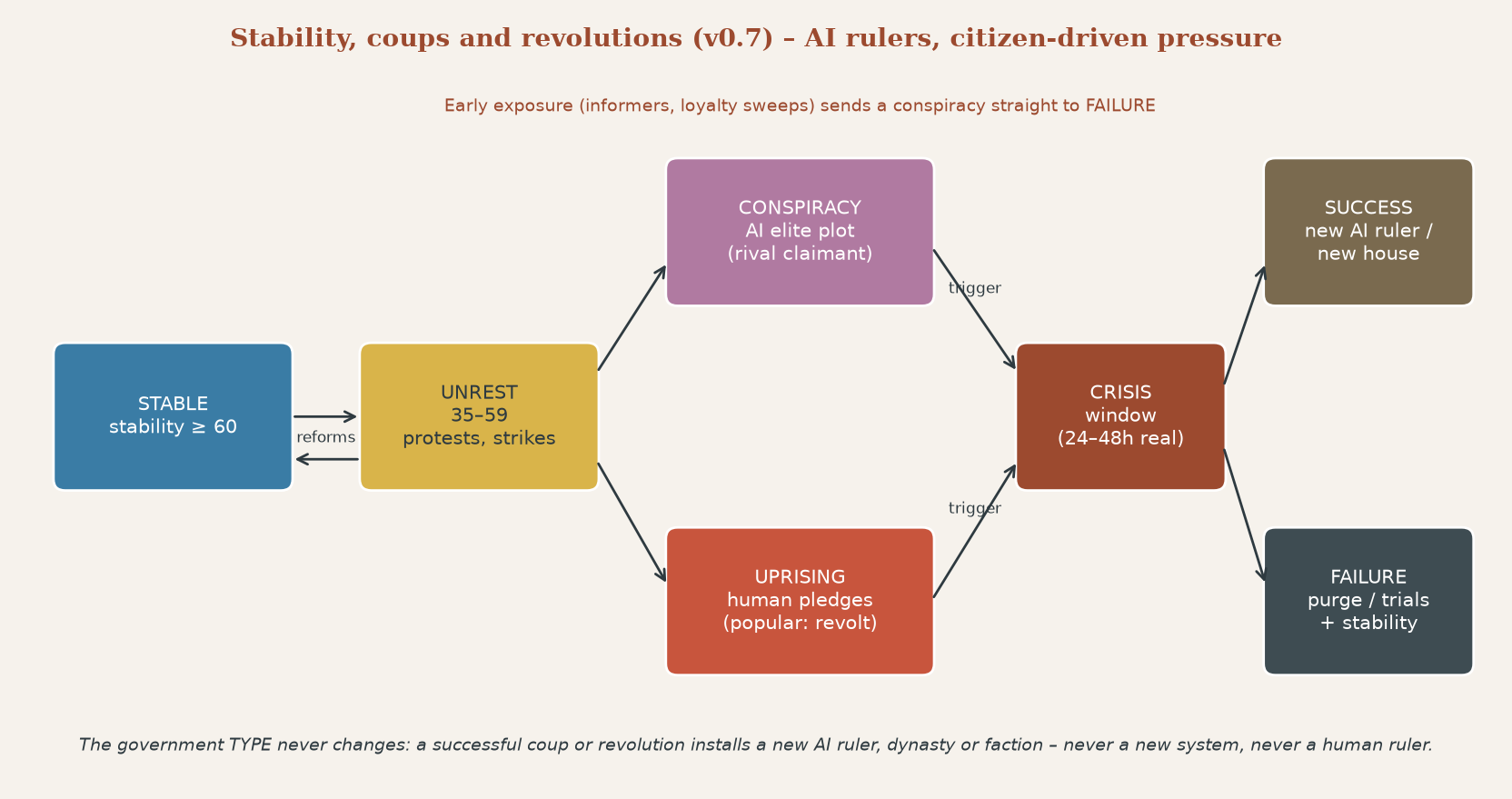
10.1 Stability and Unrest
- Stability is recalculated each game day (about every 2 real hours) from food/ration coverage, employment, war score, inequality, legitimacy, repression, AI promise-keeping, Currency Confidence and Religious Harmony (Section 14.5).
- Repression raises Stability now and adds hidden Grievance that raises Unrest later – still the central trade-off, now made by AI leaders and felt by citizens.
- Unrest is computed from human and AI citizens, with human actions (protests, strikes, sabotage quests) weighted far higher (Section 11.9). Below Stability 60, Unrest events begin; below 35, Crisis becomes possible.
10.2 AI elite coups and purges
- Plots form among AI personas whose opinion of the ruler and own ambition cross thresholds; the AI Governance service runs plots as secret structured objects (members, Power Weight, exposure risk).
- Power Weight thresholds by nation [ASSUMPTION]: Aurelle 50% of the Guard + 3 AI great lords; Korund AI Presidium supermajority + Marshal or Security chief; Meridian AI Standing Committee majority + one command; Ilmar AI Elders’ unanimity (Writ of Dimming); Varkand 3 of 5 Commands or 50% of the capital garrison; Fulmara ‘Harbor Coup’ – AI Harbor Guard captain + 30% of shares (shares are human-held, so it needs human holders’ consent through a share vote).
- Citizen influence: sustained Unrest, failed quotas, low piety or lost plebiscites raise the odds that AI elites plot and succeed; loyal citizens’ actions lower them. Human soldiers in the capital garrison choose sides during the Crisis Window.
- Strike: a Crisis Window (24–48 real hours) opens publicly where the system allows (Aurelle, Varkand, Meridian) or as a rumor event (Korund, Confluence). The outcome is computed from committed Power Weight, Legitimacy, Stability and human soldiers’ choices.
- Outcome: success installs the plot’s AI ruler; failure triggers AI purges and capped penalties for any humans who openly joined the losing side.
10.3 Citizen-driven overthrow and pressure
| System | What citizens can do | Threshold and result |
|---|---|---|
| Aurelle (monarchy) | Pledge to an AI claimant of a rival house; join a Movement; protests, strikes, sabotage quests; soldiers choose sides | When Tier-1 human pledges reach 15% of weekly-active human citizens and Unrest ≥ 60 for 48 real hours [ASSUMPTION], a Rising opens a Crisis Window. Success crowns the claimant and founds a new AI royal house. |
| Varkand (junta) | Back an AI rival Marshal (or a Colonels’ slate); soldier loyalty pledges; vote ‘No’ in the plebiscite | Rival backing by 15% of weekly-active humans, including 25% of human soldiers in a Command, plus Unrest ≥ 55 [ASSUMPTION] → citizen-backed coup Crisis Window. Success installs a new AI Directorate (the rival plus AI allies); officers who fired on citizens are barred from the next Conclave. |
| Korund, Meridian, Confluence (party-states) | Meet or miss quotas, loyalty actions, protests and strikes (riskier in Korund), underground congregations | No citizen pledge mechanic. Sustained Unrest (≥ 65 for 7 real days [ASSUMPTION]) forces an emergency Presidium session / Congress in which AI factions favoring reform gain weight; the AI leader may be purged and replaced by an AI successor. |
| Ilmar (theocracy) | Piety, pilgrimage, petitions; vote for reform-minded AI Assembly candidates | Low national Piety plus high Unrest lets AI Elders pass a Writ of Dimming; the new AI Oracle comes from reform-endorsed Elders. |
| Fulmara (oligarchy) | Buy and vote shares; join a Dock Strike; join a Movement for a Great Recharter | A Rising backed by 20% of active humans forces a Great Recharter: 30% of the top holders’ shares are redistributed among Movement members and the Tribune pool [ASSUMPTION]. |
| Kindle, Hoarvale, Veldwood (democracies) | Vote, recall, referendum, initiative, protest | No coup or revolution mechanic – elections are guaranteed by Charter Limits. |
- Only humans count toward thresholds. AI citizens add capped background Unrest but cannot pledge or join Movements (Section 11.9).
- Faith and risings: suppressed congregations add Revolutionary Pressure; in Aurelle and Ilmar a rising backed by clergy of the state faith gains Legitimacy.
- Failed risings: capped penalties for human leaders of the Movement (pledges are visible to the AI Security organs only in aggregate unless a human informer reports – Section 11.10); Grievance remains, so repeated risings get easier unless the AI ruler addresses causes.
- Varkand is still the coup nation: coups among AI Marshals are routine politics with lower Stability costs, a 14-day cool-down and a legitimacy bonus for coup leaders who win the next plebiscite.
10.4 Transition matrix (AI rulers)
| Nation | Normal transition | Forced transition | Citizen trigger | No eligible successor |
|---|---|---|---|---|
| Kindle | Election every 120 days; AI Vice President on vacancy | Impeachment by AI Assembly (2/3) + AI Court | Recall petitions; elections | AI Speaker; special election within 14 days |
| Confluence | Party Congress every 150 days | AI Central Committee no-confidence (2/3) | Unrest-forced emergency Congress | Emergency Congress within 10 days |
| Meridian | Congress every 150 days | AI Standing Committee removal (5 of 7) | Unrest-forced emergency Congress | Emergency Congress within 10 days |
| Korund | Scripted death; designated successor confirmed | AI Presidium purge | Unrest-forced emergency Presidium | AI Presidium elects a successor |
| Aurelle | Death/abdication → designated heir | AI palace coup | Citizen Rising behind a claimant (new house) | AI Great Council of lords elects a new house |
| Ilmar | Death of Oracle → AI Elders elect | Writ of Dimming | Piety collapse + Unrest | AI Elders elect from AI Lumen-Masters |
| Hoarvale | Moot election ≤ 120 days; new investiture after coalition collapse | Constructive no-confidence; Act of Settlement | Human votes; Act of Settlement referendum | AI Speaker invites party leaders; Sovereign’s reserve power |
| Varkand | Chair rotation every 60 days | AI coup; Conclave after a failed plebiscite | Citizen-backed coup behind a rival Marshal | AI Conclave of Colonels elects five Marshals |
| Veldwood | Assembly and Council elections every 120 days | AI Federal Court removal for misconduct | Referendums; elections | Special Assembly session |
| Fulmara | Lodestar every 90 days; Ten yearly | Ten removes the Lodestar (7/10); takeover; Harbor Coup | Share votes; Dock Strike; Great Recharter | Grand Council lot-and-ballot within 7 days |
10.5 AI leader lifecycle (replaces the v0.6 inactivity protocol)
| Event | Rule |
|---|---|
| Ageing and mortality | Personas age with the World Clock. Life-tenure offices (Korund’s Chairman, Ilmar’s Oracle, Aurelle’s and Hoarvale’s monarchs) have a scripted mortality window (game age 70–90, i.e., several real years [ASSUMPTION]), announced in-world as illness first, so succession politics can build. |
| Retirement and defeat | Defeated or retired personas become elder-statesman Notables or leave play; they cannot hold office in the same nation for one Age [ASSUMPTION]. |
| Persona refresh | Studio staff may retire a persona that tests poorly (Section 22.15) only through an in-world event (illness, resignation) and never during an election, Crisis Window or war [design rule]; logged publicly as a staff action OOC. |
| Candidate Forge | Parties, factions, houses and Commands always keep a bench of at least 3 eligible personas, generated from templates when short, so every election has distinct AI candidates. |
| Outage | Covered by Section 8.19. |
Design intent
Removing human office removes leader inactivity, power-based harassment between players and ‘drain and quit’ sabotage as problems. The drama moves to the relationship between citizens and their AI rulers – and to AI rulers’ rivalries with each other.
10.6 Founding governments at launch
- At shard launch each nation starts with an inaugural AI government seeded from its SystemTemplate (no Caretaker period is needed any more).
- Founding Period (first 30 real days): war declarations stay disabled; the AI leadership governs with a ‘founding programme’; citizens accumulate tenure, Standing, Favor and Piety, and Fulmara’s share register is allocated by human trade volume and service.
- Day 30 events: Kindle, Hoarvale and Veldwood hold their first elections (human votes, AI candidates); the Confluence and Meridian hold Founding Congresses of AI factions weighted by the founding month’s output and loyalty; Korund’s AI Chairman is confirmed by the AI Congress; Aurelle’s rival AI houses publish their claims; Ilmar’s AI Elders confirm the Oracle in a Great Vigil whose attendance sets the founding Piety; Varkand holds its first Mandate Plebiscite; Fulmara elects its first AI Lodestar by share vote.
Last updated on