6. World & Map Design
The game is set on Harimu – the in-world name of the planet the ten nations share, and the source of the game’s title. Each shard is its own persistent copy of Harimu.
The world of Harimu is a single, finite plane of square tiles (‘squares’), shared by all nations on a server (a shard). Squares are the atomic unit of ownership, production, movement and war. Finite space is the source of tension: every square one nation gains is a square nobody else can have.
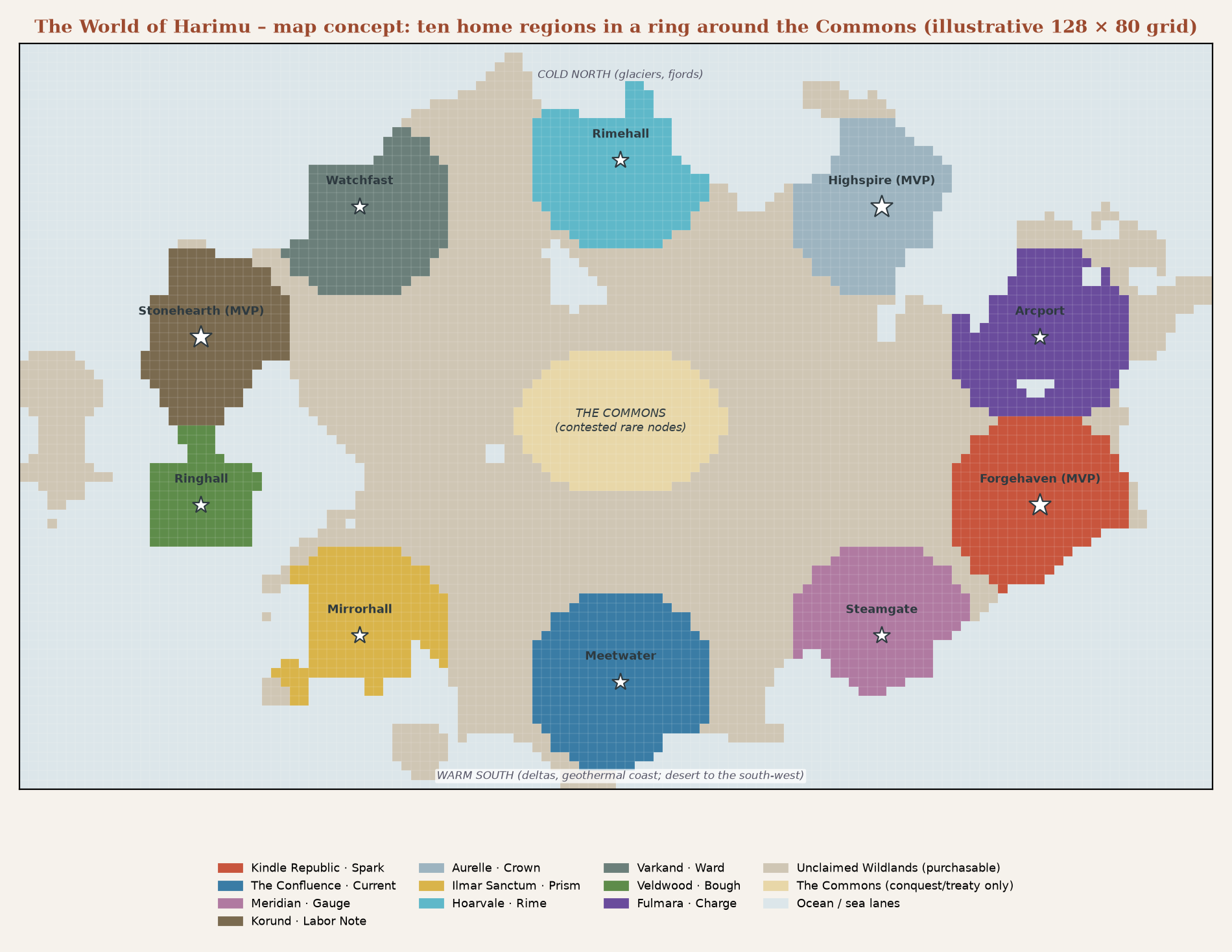
6.1 Map structure
| Zone | Description | Acquisition |
|---|---|---|
| Heartland | Each nation’s core: capital plus a ring of starting squares (about 400 squares at MVP map scale, about 1,200 at full scale [ASSUMPTION]). | Never capturable. Guarantees that no nation – and therefore no citizen – can be eliminated. |
| Frontier | Squares a nation acquires after launch. | Purchasable when unclaimed; transferable by treaty; capturable in war. |
| Wildlands | Unclaimed neutral land between nations, with ordinary resources. | Bought from the World Registry, or claimed by founding a city. |
| The Commons | A central region of rare resource nodes and wonders sites. | Cannot be bought. Claimed only by war, treaty or a joint-development agreement – the world’s flashpoint. |
| Sea lanes | Ocean squares with trade routes and fisheries. | Not ownable; patrolled; blockades are a war action. |
6.2 Square attributes
| Attribute | Values / notes |
|---|---|
| Terrain | Plains, forest, old-growth forest, hills, mountains, wetland, fog moor, desert, salt flat, tundra, glacier/fjord, volcanic badland, cliff/plateau, storm headland, coast, river edge. |
| Climate / biome | Volcanic savanna (Kindle), delta and coast (Confluence), geothermal coast (Meridian), mountain plateau (Korund), cliffs and steppe (Aurelle), desert and salt flats (Ilmar), glacier, fjord and tundra (Hoarvale), fog moor and marsh highland (Varkand), old-growth forest (Veldwood), storm headland and archipelago (Fulmara). A matching biome boosts the corresponding signature industry by +10–20% [ASSUMPTION] – ordinary geography, not an element system (removed in v0.3). |
| Resource node | Food, timber, stone, ore, fuel, cloth fiber; rare: Emberstone, Riverpearl, Ironroot, Skysilk, Geotherm core, Sunglass, Frostcore, Hazequartz, Heartwood, Stormcells (Section 12). |
| Improvement | Farm, mine, lumber camp, workshop, factory, port, road, fort, temple/meeting house, holy site (Section 14.4), bank or exchange office, palace, monument, housing block. |
| Owner / status | Nation, unclaimed, contested (during war), occupied, demilitarized (by treaty). |
| Population capacity | How many citizens can live there (cities: dense; rural: sparse). |
| Defense value | Terrain + fortifications; used in battle resolution (Section 15). |
6.3 Map size and shard sizing
- MVP map: 128 × 128 squares, about 40% land, three home regions plus Wildlands and a small Commons [ASSUMPTION].
- Full-scope (1.0) map: 512 × 320 squares (163,840) with ten home regions in a ring around a larger central Commons, plus Wildlands between neighbors and an inner Wildlands belt [ASSUMPTION]. Rationale: v0.1’s six-nation map (384 × 256 = 98,304 squares) gave about 6,550 land squares per nation at 40% land; 512 × 320 at 40% land keeps the same ~6,550 per nation, so per-nation density and travel times stay comparable (arithmetic, not measured data).
- Ring topology: each nation borders two neighbors, the Commons and the sea. This keeps every nation within reach of the Commons (the flashpoint) without any nation being surrounded; sea lanes connect non-neighbors for trade. With ten nations the Commons radius grows (about 1.6× the six-nation area [ASSUMPTION]) and gains a second ring of rare nodes so it is not decided by the two nearest powers.
- Shard capacity target (revised v0.7): because every office is held by an AI leader and AI citizens fill the population (Section 11.7), politics no longer needs hundreds of humans per nation. The human viability floor drops from about 150 to about 25 weekly-active human citizens per nation, i.e., about 250 per shard, before a shard opens to the public; AI citizens top each nation up to a simulated population floor of about 1,000 [ASSUMPTION – validate in alpha]. Comfortable target: 100–3,000 humans per nation [ASSUMPTION]. New shards open when existing ones fill (Section 19).
- Smaller test shards: alpha and special-event shards may run a subset of nations on a 128 × 128 or 256 × 192 map; public 1.0 shards always open with all ten.
- No wipes, ever (decided v0.4). Every shard is fully persistent – there are no seasonal shards or resets; long-term pacing comes from Ages and the map’s finiteness (Section 17). New shards may open later for capacity or a fresh start, but existing shards never reset.
Last updated on