14. Religion & Faiths
New in v0.3. Religion is now a nation attribute alongside government, economy and currency. Six invented world faiths cross borders; each nation has a fixed official stance – from compulsory state faith to enforced state atheism – that decides how freely citizens may practice, preach and convert. Like the system itself, a nation’s stance is immutable (decided v0.4: fixed like its government – no supermajority or revolution can change it); laws can only move enforcement within the stance’s band.
Ground rules for religion in Harimu
- All faiths are invented. None is a stand-in for a real religion; none uses real scriptures, prayers, symbols, titles, dress, holy places or calendars. They are built from broad, widely shared archetypes (a scriptural hierarchy, ancestor veneration, a seasonal folk faith, a patron devotion of travelers, a contemplative path, a charity movement).
- Respect over satire. Every faith is presented as meaningful to its believers, with virtues and a community worth belonging to; satire in this game is aimed at power, never at belief. No faith is ‘the evil one’.
- Only the player chooses a citizen’s faith. States can reward, pressure, restrict or ban practice within capped limits, but no leader, system or missionary can change a citizen’s faith attribute.
- In-game faith is not real faith. Moderation never treats a citizen’s in-game faith as information about the player, and harassment over real-world religion is banned (Section 21).
14.1 The six world faiths
| Faith | Archetype | Core teaching (invented) | Practice & clergy | Festivals (game time) | Holy site |
|---|---|---|---|---|---|
| Lumen Canon | Hierarchical, scriptural faith | Truth is light passing through a clear vessel; a life of honesty, duty and clarity lets the light through. | Daily Vigil, weekly Stilldays, pilgrimage; orders of Lamplighters, Glaziers and Wardens; Lumen-Masters; headed worldwide by Ilmar’s Supreme Oracle. | Long Light (midsummer vigil); Clearing (new-year renewal of vows) | Prism Spire, Mirrorhall (Ilmar) |
| Kinward Rite | Ancestor and lineage veneration | The living are stewards between those who came before and those who come after; keep your oaths and your name. | Household hearths with carved name-stones; rites of birth, marriage, death and oath-taking; Hearth-Keepers and Name-Readers. | Night of Names (remembrance); Oath Day | Hearth of First Names, Highspire (Aurelle) |
| The Round | Seasonal folk faith | All things turn and return; live in step with the seasons and the community. | Open-air circle gatherings at each season’s turn; painted season-posts; Circle-Elders chosen by lot; no central head. | Turning Days at each of the four seasons (every 7.5 real days) | The Old Ring, Veldwood |
| Fair-Wind Vow | Patron devotion of travelers and traders | A company of patron virtues – Honest Measure, Safe Return, Good Fortune – watches over those who travel and trade fairly. | Vows before voyages and deals; votive ship models; Harbor Chaplains and Pilots; chapels in ports. | Launching (start of sailing season); Safe Return | Harbor of Vows, Arcport (Fulmara) |
| The Quiet Path | Contemplative, non-theistic practice | Attention, restraint and compassion can be trained; no god is required. | Daily stillness practice; retreats; Teachers rather than priests; may be held alongside one other faith. | Still Week (retreat); Lantern of Attention | High Retreat, in Korund’s mountains (closed unless Korund grants access) |
| The Open Hand | Universalist charity movement | All are equal before the Giver; what you hold is held in trust for those in need. | Bread halls and almsgiving; Almoners and Stewards; strong voice for the poor – sometimes for strikes and reform. | Bread Day; Day of the Open Door | Bread Hall, Meetwater (Confluence) |
| Unaffiliated | Secular / no faith | — | A valid choice everywhere; in Korund it is the official doctrine (state atheism). | Civic holidays only | — |
The Commons – Concord Stones: a shared holy site sacred to the Kinward Rite, The Round and the Open Hand. It cannot be bought or captured; custody passes only by a joint custody treaty, and access for pilgrims is a recurring diplomatic flashpoint [design intent]. Faith names are working names pending the trademark search and sensitivity review (Section 1.4).
14.2 Official stance by nation
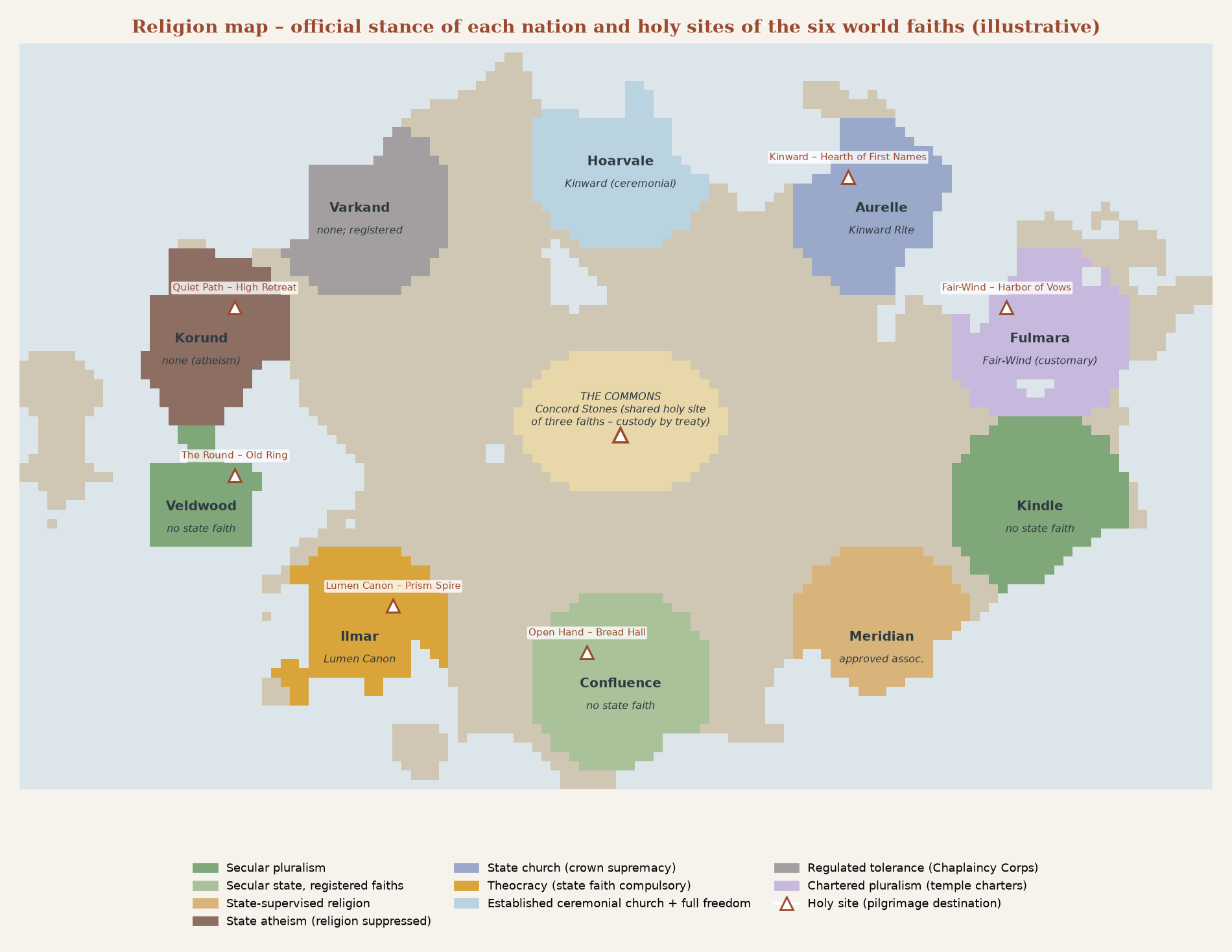
| Nation | Official stance | State / favored faith | Other faiths | Freedom to choose, convert, leave | Enforcement band (laws may move within it) |
|---|---|---|---|---|---|
| Kindle | Secular pluralism (strict separation) | None | All free; religious parties allowed | Fully free | Assembly sets tax-exemption rules; may never favor or ban a faith |
| Confluence | Secular state, registered faiths | None | Legal once registered with the Bureau of Faith Affairs; missions licensed | Free; Party cadres may not hold clergy office | Registration strictness; license quotas for missionaries |
| Meridian | State-supervised religion | Approved national associations (Kinward, Round, Fair-Wind, Quiet Path) | Lumen Canon (foreign-led) and Open Hand private only | Conversion only into registered associations; Party members Unaffiliated | How many associations are approved; SEZs may be looser |
| Korund | State atheism – religion suppressed | None (scientific collectivism) | All banned; underground only | Professing any faith is illegal | Crackdown intensity (raids, Suspicion weight) – never legalization |
| Aurelle | State church with crown supremacy | Kinward Rite (Monarch = Keeper of the Hearth) | Private worship; commoner dissenter levy | Leaving Kinward costs Royal Favor; Counts and Dukes must conform | Size of the dissenter levy (0–10% of income, capped [ASSUMPTION]); private-worship rules |
| Ilmar | Theocracy – state faith compulsory in public | Lumen Canon | Fair-Wind Vow and Quiet Path registered minorities with own endowments; others private | Joining the Canon encouraged; Lapse = Piety loss and clerical-rank bar for 30 real days | Strictness of public duties; minority endowment rules |
| Hoarvale | Established ceremonial church + full freedom | Kinward Rite as the Crown’s Rite (ceremonial only) | All free | Fully free; no rank or honor needs membership | Ceremonial only |
| Varkand | Regulated tolerance via the Chaplaincy Corps | None (a Directorate may court one) | Registered; private only at Red Alert | Free; officers must declare their faith | Registration rules; Alert Level |
| Veldwood | Secular pluralism (Grove civic festivals) | None | All free | Fully free | Groves may adopt civic festivals; never ban or privilege a faith |
| Fulmara | Chartered pluralism | Fair-Wind Vow customary (no compulsion) | Free with a temple charter | Fully free | Temple-charter fee (capped) |
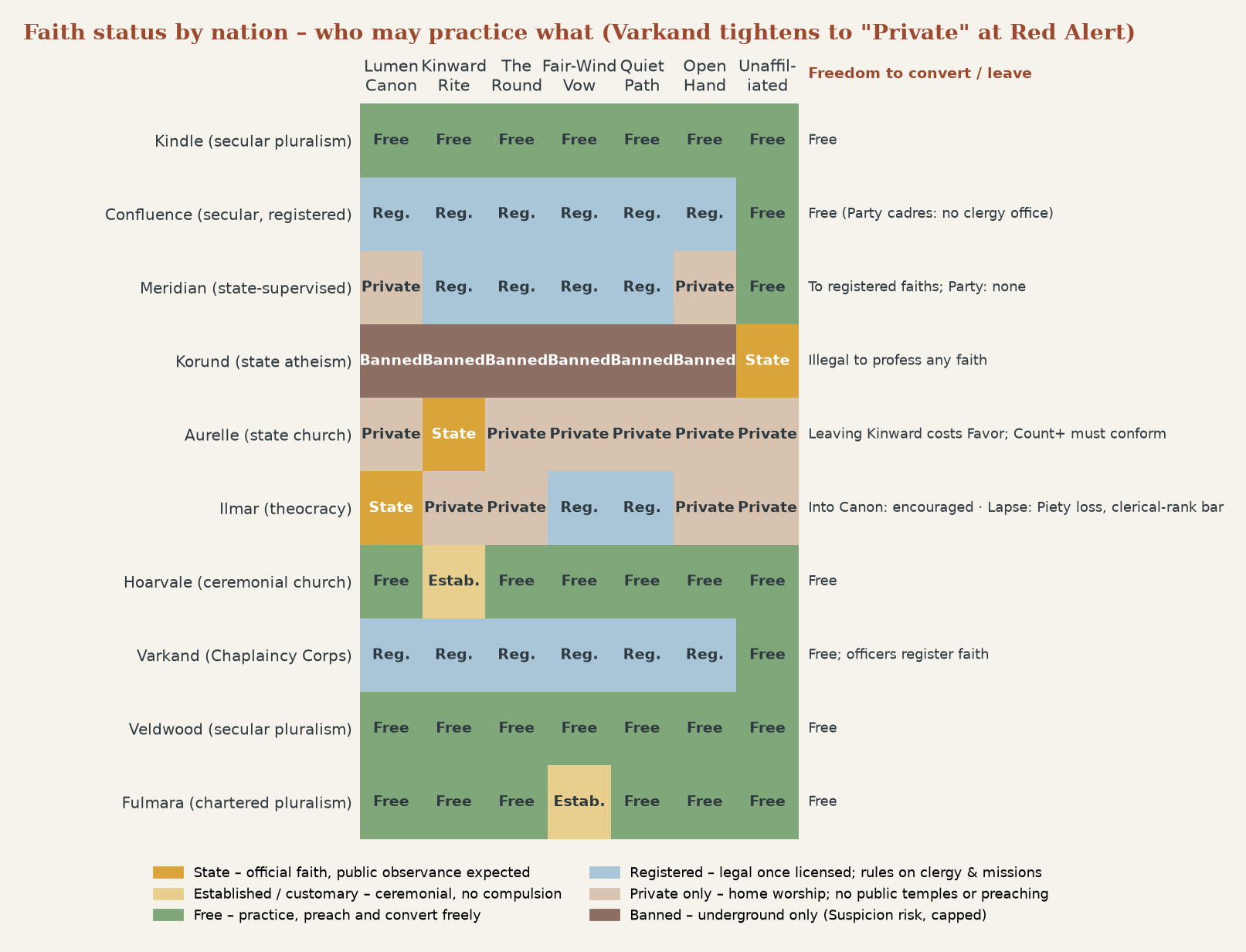
14.3 Penalties and their caps
- All faith-related penalties are capped like every other punishment and enforced as AI behavior constraints (Section 8.18): Korund raids lead to Correction Duty ≤ 7 real days; Ilmar’s Lapse bars clerical ranks for 30 real days and costs Piety but nothing else; Aurelle’s dissenter levy is capped; Varkand can only move gatherings to private worship.
- No penalty removes access to the daily loop, voting rights the system grants, or real-money purchases. No citizen can be forced to convert, and conversion prompts are always opt-in.
- A citizen may change faith at most once per 60 real days [ASSUMPTION], to stop faith-hopping for bonuses.
14.4 Religion gameplay
| System | Design |
|---|---|
| Faith attribute | Chosen at character creation from what the nation allows (in Korund the only public option is Unaffiliated, with an optional hidden faith held in secret); changed later only by the player. |
| Devotion (0–100) | Rises with worship, festivals, charity, pilgrimage and clergy service; decays slowly. Gates clergy offices; gives small social rewards (festival roles, morale, reputation within the congregation). In Ilmar, Lumen Devotion is Piety and raises the weight the AI Oracle gives a citizen and unlocks clerical ranks (Section 8.13). Devotion never boosts production or combat [design rule, confirmed v0.4] – no ‘best religion’ meta. |
| Congregations | Player organizations (like parties or houses) attached to a temple or meeting house in a city; members, clergy, donations, a private channel; registration or temple charters where required. |
| Clergy roles | Congregation roles per faith (Lamplighter, Hearth-Keeper, Circle-Elder, Harbor Chaplain, Teacher, Almoner…), open to human citizens because they are service within a congregation, not state office (Section 5.6); AI Notables fill gaps. Clergy lead services, festivals, weddings and funerals (heir ceremonies), run charity that raises Wellbeing, and counsel members. Each faith has a cross-border, advisory Faith Council of senior clergy – except the Lumen Canon, headed by Ilmar’s AI Oracle; Ilmar’s state clerical offices (Elders, Synod, High Judges) are AI. |
| Holy sites | Seven sites (Figure 7). Visiting one is a pilgrimage quest that grants Devotion and a cosmetic token; the custodian nation sets access, and foreign pilgrims need visitor or pilgrimage access (Section 13.2). Holy sites cannot be damaged, desecrated or destroyed – war only changes custodianship of a captured site. |
| Festivals | Each faith has two or more festivals in game time. A nation can endorse (public holiday: Stability +, one fewer shift that game day), tolerate, or – where its stance allows – ban (Grievance among adherents). Festival cosmetics and décor follow Section 26. |
| Temples and meeting houses | Buildings in sacred districts; size grows with congregation activity; serve as social hubs and, in pluralist nations, as polling places and soup kitchens. |
14.5 Stability, legitimacy and Religious Harmony
- Religious Harmony (0–100) per nation rises with endorsed festivals, clergy charity and holy-site access, and falls with raids, bans, disputes between congregations and denied pilgrimages. It feeds Stability (Section 10.1).
- Legitimacy links: Aurelle’s coronation needs the Hearth-Keepers’ blessing; Ilmar’s whole state is the Canon; Hoarvale’s Crown’s Rite gives ceremony but no power; a Varkand Directorate that wins a faith’s public blessing gets a small plebiscite bonus; in democracies, faiths act like any civil-society group.
- Reform politics: the Open Hand can call charity strikes that raise pressure on governments over poverty; congregations may endorse AI candidates where the law allows (Kindle, Hoarvale, Veldwood, Fulmara), and congregation turnout is a petition-weight signal the AI leaders read.
14.6 State atheism and suppression (Korund; restrictions elsewhere)
- In Korund, faith is a forbidden, private act – like the hidden radio. A hidden shrine (a home item obtained through the gray market, never sold in the store) lets a citizen practice, gain Devotion and meet in underground congregations (secret channels, like plots).
- The AI State Security organ investigates shrines and meetings by rule (Suspicion signals, informer reports by human citizens); each discovery adds Suspicion and may lead to capped Correction Duty. Active suppression raises Stability now and Grievance later; underground congregations add Revolutionary Pressure while banned (Section 10.3).
- The AI Chairman can order a Thaw (lighter enforcement for a Plan period: Stability bonus, less Grievance) or a Campaign (harsher enforcement) – the stance itself never changes.
- Low-key by design (decided v0.4): underground worship stays playable but quiet – an optional background activity, never part of the tutorial, store or marketing. Discovery is abstract (an ‘inspection found a shrine’ notice; no arrest scenes, violence or desecration shown); a first discovery adds Suspicion only, and Correction Duty (≤ 7 real days) applies only to repeat discoveries; a congregation can be raided at most once per 14 real days [ASSUMPTION]; State Media may not name individual believers; and a Campaign raises enforcement only inside these caps.
- Meridian’s restrictions on the Lumen Canon and the Open Hand, and Varkand’s Red Alert limits, use the same tools at lower intensity.
14.7 Theocracy’s reach: Ilmar and the Lumen Canon abroad
- The AI Supreme Oracle is head of the Lumen Canon everywhere it is allowed. Abroad, Lumen clergy obey local law first (Charter Limit) but can carry the Oracle’s Counsels – non-binding guidance; following them raises a believer’s Devotion.
- Great Pilgrimage: once per game year the Oracle can call the faithful to Mirrorhall; mass foreign arrivals boost Ilmar’s prosperity and soft power, and host nations must grant or refuse pilgrimage access.
- Veil: once per Age per target [ASSUMPTION], the Oracle may declare a Veil on a nation that persecutes the Canon: Lumen believers there gain Grievance, and treaty costs between Ilmar and the target rise. A deliberately powerful, rare diplomatic weapon; it never compels any player.
- Other faiths’ Faith Councils have softer cross-border tools (appeals, aid drives), so the theocracy is the only state that wields a faith as foreign policy.
14.8 Missionaries and conversion across borders
- At launch (decided v0.4): cross-border missionaries are live from Early Access (the MVP three), not deferred – with the cooldowns below: one invitation per citizen per 14 real days, at most one faith change per 60 real days (Section 14.3) and a full mute option.
- Missionary is a career. Abroad it needs a visitor pass plus the host’s permission: free in pluralist nations, licensed in the Confluence, Meridian (registered associations only) and Varkand, Kinward Rite only in Aurelle (other faiths are private-only there), banned in Korund and – for non-Canon faiths – in Ilmar.
- Missionaries hold open services, run charity and raise a city’s Faith Presence (which unlocks temples and festivals there). They can send a citizen at most one invitation per 14 real days [ASSUMPTION]; citizens can mute missionaries entirely. Conversion happens only if the citizen accepts.
- Illegal preaching risks arrest, deportation and a visitor ban (capped); a missionary’s home nation takes a small World Reputation hit if its missionaries are repeatedly expelled.
- Missionary work is never a cover for spying – espionage is a separate career with its own risks (Section 15.5).
14.9 Sensitivity and production notes
- Each faith gets a short ‘faith bible’ (beliefs, practices, art and music kit, what to avoid), reviewed by sensitivity readers from several real religious and secular backgrounds before reveal [to recruit].
- Art and music are original: no real liturgical texts or chants, no real religious symbols or vestments, and no motif that closely resembles one (Sections 24–25).
- Codex entries describe each faith with respect and note that it is invented; satire is aimed at rulers who exploit faith, not at belief.