9. Elections Module (Citizens Elect AI Candidates)
Revised in v0.7: humans vote, AI personas run. The elections module is a reusable service that powers Kindle’s presidential, Assembly and mayoral elections and recalls, and – with different settings – the Confluence’s People’s Assembly, Meridian’s ward councils, Ilmar’s Assembly of the Faithful, Hoarvale’s Moot, Varkand’s Mandate Plebiscite, Veldwood’s Vote Days and Assembly, and Fulmara’s share-weighted Grand Council, Lodestar and Tribune ballots. Every candidate is an AI persona; every voter who counts at full weight is a human citizen; AI citizens vote only inside a capped bloc (Section 11.9). Kindle’s presidential election is the reference implementation; the referendum and initiative engine (Section 9.7) and weighted and lot-based ballots (Section 9.8) are reusable components.
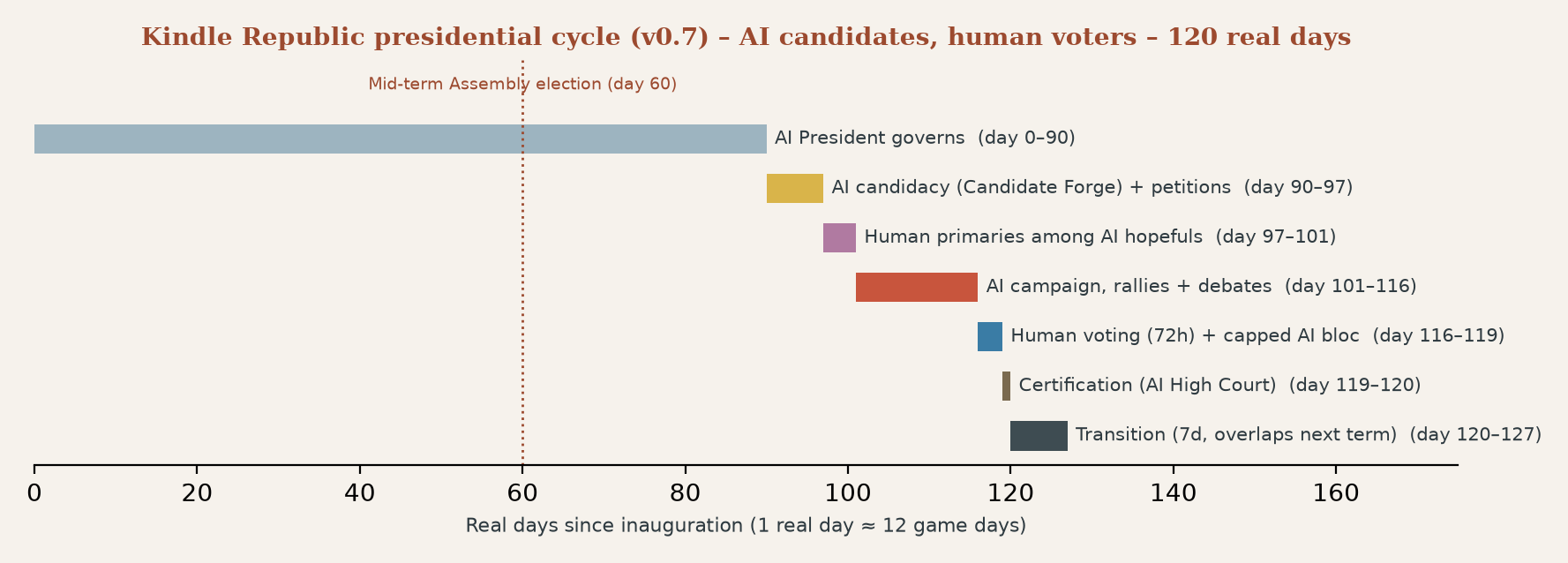
9.1 Cycle and calendar
| Phase | Real-time window | What happens |
|---|---|---|
| Governing | Days 0–90 | The AI President and AI Assembly govern; the Pledge Tracker shows each pledge’s status. Mid-term Assembly election at day 60 (half the seats). |
| Candidacy | Days 90–97 | Each AI party nominates 1–3 hopefuls from its roster (the Candidate Forge spawns new personas if a party’s bench is thin); human party members submit and up-vote platform planks; independents may enter if citizen petitions reach 2% of eligible human voters [ASSUMPTION]. |
| Primaries | Days 97–101 | Human party members vote among the AI hopefuls (instant-runoff); AI citizens do not vote in primaries. |
| Campaign | Days 101–116 | AI rallies in city squares (3D scene + generated speech), posters on owned squares, newspaper endorsements by human journalists, two debates (Section 9.4), town halls answering citizen questions, human volunteers’ canvassing quests. |
| Voting | Days 116–119 (72 hours) | A 72-hour window so every time zone can vote. Ballots secret; results hidden until close. |
| Certification | Day 119–120 | Automatic count; the AI High Court certifies within 24 hours; challenges only for detected fraud flags (Section 9.5). |
| Transition | Days 120–127 | Inauguration address; the outgoing AI President cannot spend treasury or declare war; the incoming persona’s memory is seeded with a briefing generated from the logs and its platform. |
9.2 Eligibility
| Requirement | Vote (human citizens) | Stand as a candidate |
|---|---|---|
| Who | Any human citizen meeting the rows below | AI personas only – humans can never stand (open question R9, Appendix B) |
| Citizen tenure | ≥ 14 real days | — |
| Verification | Tier 1 (email + phone) – Section 20 | — |
| Activity | Logged in at least once in the last 14 real days | — |
| Game age | Citizen aged 18+ | Persona aged 30+ for President |
| Term limits | — | AI President: 2 consecutive terms; may run again after one term out. Assembly: none. Mayor: 3 terms. |
9.3 Voting methods
- President and Mayors: instant-runoff (ranked) voting.
- Assembly: each city district elects AI members in proportion to its eligible voters (party-list PR within the district).
- Referendums: the AI Assembly or a human petition can put a law to the people (simple majority, 20% human-turnout quorum [ASSUMPTION]).
- AI bloc (v0.7): AI citizens’ preferences are tallied as one Simulated Public bloc whose total weight is capped (Section 11.9). Results show human votes and the AI bloc separately.
- Turnout incentives: a cosmetic ‘I Voted’ badge and Civic Rank XP – never currency.
9.4 Campaign systems
| System | Design |
|---|---|
| AI parties | Persistent AI organizations with a name, invented ideology inside the nation’s bands, colors, a roster of AI personas and a platform. Human citizens join as members: pay dues, vote in primaries, up-vote platform planks the party AI must consider, volunteer. |
| Platform cards | Each AI candidate picks up to 5 pledges from a structured list (e.g., ‘Lower income tax to 20%’, ‘Build 3 frontier cities’, ‘Trade deal with Meridian’). Once elected, pledges become utility-model goals; broken pledges cost Legitimacy and show up in the Pledge Tracker and press. |
| Debates | Two scheduled debates per presidential race: a live in-game stage and transcript. Questions come from human journalists and from citizen-submitted questions ranked by up-votes (one vote per Tier-1 citizen); the AI candidates answer in character, constrained to their platform and the facts in the digest; a fact-check panel shows the system’s true figures beside any claim. |
| Rallies and speeches | Scheduled events in city squares: generated speech text (and optionally synthesized voice, a later option), crowd made of attending human avatars and AI citizens; clips publish to the news feed, labeled AI. |
| Town halls | Asynchronous Q&A: citizens post questions for 24 real hours, the candidate answers the top-ranked 10 [ASSUMPTION]. |
| Campaign finance | Citizens and companies donate in-game money to AI parties; donations buy ad placements and rally slots, never votes; spending caps per candidate; all donations publicly disclosed. |
| Ground game | Human volunteers complete canvassing quests that raise a candidate’s visibility in districts – visibility, not votes. |
| Polling | System polls from random samples of voluntary human voter-intent answers plus the AI bloc, shown separately with a margin indicator. |
9.5 Integrity
- One Tier-1 verified human account = one vote; ballots are separated from voter identity after de-duplication.
- Vote buying among humans remains an in-world crime (transfer patterns within 48 hours of voting trigger an investigation event). No one can buy, persuade or instruct AI citizens’ votes – the AI bloc is computed from simulation state only (Section 11.10).
- AI candidates cannot see individual ballots, voter lists or which human voted how; they see only published results and polls.
- Fraud flags (multi-account clusters, newly verified bursts) quarantine suspicious ballots for staff review.
- Results, turnout, AI-bloc weight and per-district counts are fully published.
9.6 Variants used by other nations
| Nation | Election | Key differences |
|---|---|---|
| Confluence | People’s Assembly (every 150 days); human Party branch votes | AI candidates, at least 2 per seat; the AI leadership does not heed the result (Section 8.9). Branch votes produce ‘work reports’ that feed loyalty signals. |
| Meridian | Ward councils in towns | AI councillors with real effect on local services only; national offices chosen inside the AI Party. |
| Korund | People’s Congress ‘approval’ ballots | One AI candidate per seat; citizens vote yes/no. A ‘no’ is secret but raises the district’s Unrest signal the AI Chairman does read. |
| Ilmar | Assembly of the Faithful (every 120 days) | Synod-vetted AI candidates; otherwise like Kindle’s Assembly. |
| Aurelle | None | No elections. Influence through Royal Favor, petitions – and claimant pledges (Section 10.3). |
| Hoarvale | Moot general election (≤ 120 days, can be early) | Regional party-list PR among AI parties, 4% threshold [ASSUMPTION]; snap-election compressed calendar; investiture and confidence votes are AI roll calls, published. |
| Varkand | Mandate Plebiscite (every 150 days) | Single yes/no; counted honestly; the AI Directorate runs the campaign but cannot see individual ballots; a ‘No’ forces an AI Conclave of Colonels. |
| Veldwood | Vote Days (every 15 days); Federal Assembly (every 120 days); Grove votes | Referendum engine (Section 9.7) – binding on the AI Council; Assembly by proportional list among AI parties. |
| Fulmara | Grand Council resolutions; Lodestar (lot-and-ballot); Tribune | Share votes by human holders bind the AI board; Lodestar candidates are AI; the AI Tribune is elected one person, one vote by non-holders. |
9.7 Referendum and initiative engine (Veldwood; also Kindle and Hoarvale referendums)
| Step | Design |
|---|---|
| Proposal | A human citizen drafts an initiative from structured law templates plus free-text rationale (filtered). Free text never changes what the law does – the template does. AI citizens and Notables cannot propose. |
| Signature drive | One Tier-1 verified human = one signature; thresholds count human citizens only; signature buying is a crime. |
| Validation | The rules engine checks count and legality; an AI Federal Court rules on disputes within 48 real hours, publishing its reasoning. |
| Ballot Booklet | Proponents (humans) and opponents (humans, or the AI Council if no human files) each submit a 300-word case; the AI Council adds a recommendation; The Canopy gives balanced airtime. |
| Vote Day | Up to 4 items, 72-hour window; double majority (voters + Groves) where required; results per Grove. |
| Implementation | A passed measure binds the AI Council (Section 8.16): it executes within 7 real days through its legal action set; progress is public. |
| Fatigue guards | Max 4 items per Vote Day, 60-day lock on re-submitting a rejected initiative, cosmetic Civic Voice reward, ‘skip with no penalty’ [ASSUMPTION – watch turnout in alpha]. |
9.8 Weighted and lot-based ballots (Fulmara)
- Weighted ballots: each share vote records holder, shares and choice publicly; the record-date rule stops last-minute share rentals.
- AI-held shares: shares held by AI citizens or the Bank of the Arc’s float vote only through the capped AI bloc (Section 11.9); the AI board itself holds no votes.
- Proxy votes: a human holder may lend votes for one session through a public proxy contract.
- Lot draws among AI candidates use a verifiable server-side seed published after each round; the electors in each round are drawn from human shareholders.
- Caps: 5% per human citizen and per linked-account group (Section 20).